Was Königstein Fortress Ever Conquered?
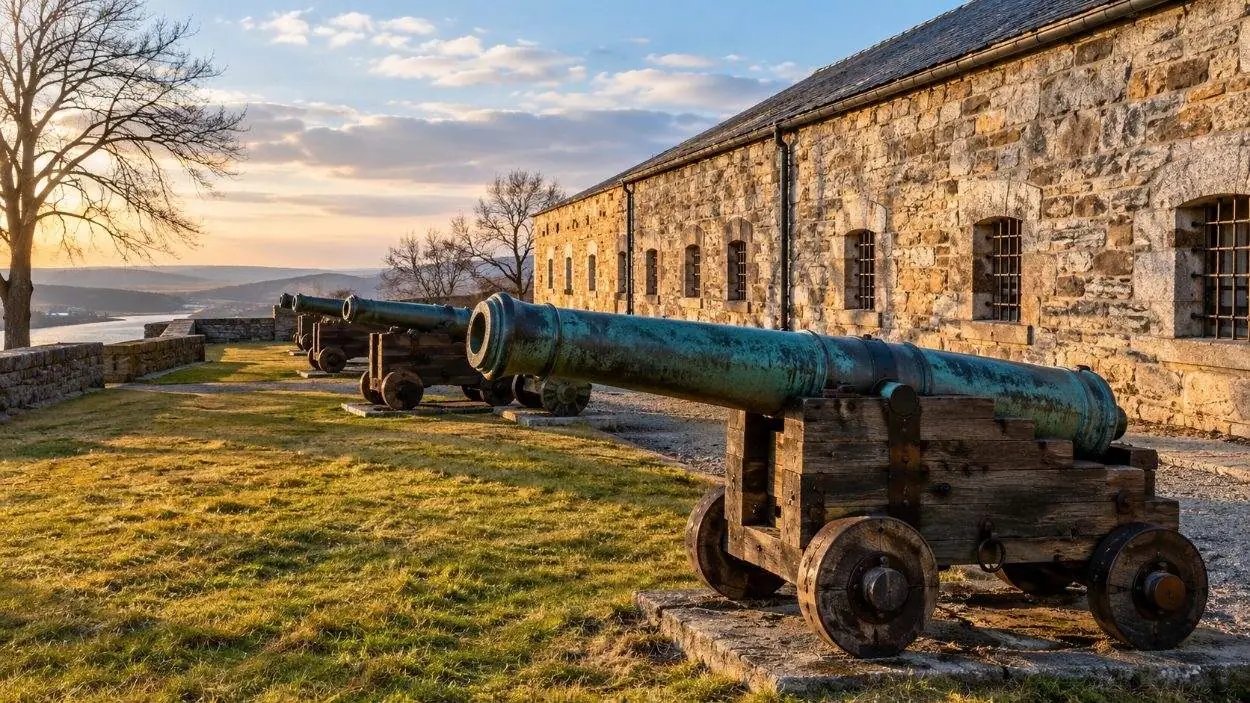
1756: the Elector watched from up here
The fortress itself was not attacked. Elector Friedrich August II sat on this plateau and watched his own army capitulate to the Prussians on the ground near the Lilienstein, across the river. The rock was untouched and the kingdom was not. That is the shape of most of Königstein’s military history: the thing is impregnable and irrelevant at the same moment.
1813: held, not taken
There was fighting before the gates. There was no fighting behind them, because French troops were already inside by arrangement with Saxony, which was allied to France. Occupation by treaty is not conquest, and the visitor who came to inspect them in June that year was not a prisoner either — see Napoleon at Königstein.
1866: the year nothing happened
By the Austro-Prussian war, long-range artillery had made a hilltop fortress militarily pointless. Nobody bothered. It is the least dramatic entry in the record and the most honest explanation of the unbeaten run: for the last century of its working life the place was not worth attacking.
1945: the caveat nobody puts on the postcard
On 8 May 1945 the fortress was surrendered to General Condé of the French army. Soviet troops came up the next day, removed what valuables were left and the German guards, and went. By then the rock had spent two years as a strongroom: from January 1943 the entire Green Vault treasure was stored up here in crates, along with 450 crates from the Historical Museum and pieces from the porcelain and painting collections, including Liotard’s The Chocolate Girl. That, rather than the unbeaten record, is the thing I would want told about this place. The full sequence is on the history page.
The reason the walls were never tested is standing under your feet. The plateau sits 240 metres above the Elbe, the ring wall runs 1,800 metres, and the walls and cliff faces reach 42 metres of height. That 42 is a height, not a thickness, whatever you read elsewhere.
Walking the wall that was never breached
There is exactly one tour on the platform that treats this rock as the destination instead of the backdrop. Nine to twelve hours, departures from Dresden and Pirna, seven or eight people maximum, four languages, and a line item each for the Lilienstein climb and the fortress. It is new enough to have no reviews at all, which cuts both ways and is worth knowing before you click.
Frequently asked questions
Has Königstein Fortress ever been captured?
Never by assault and never by siege. It did change hands: the garrison surrendered it to the French General Condé on 8 May 1945, and Soviet troops arrived the following day, removed the remaining valuables and the German guards and left. "Never conquered" is accurate. "Never taken" is not.
Was the fortress attacked in 1756 or 1813?
Not successfully, and in 1756 not at all — Elector Friedrich August II watched from the plateau while the Saxon army capitulated to the Prussians near the Lilienstein. In 1813 there was fighting before the gates, but the French were already inside by agreement with Saxony. See Napoleon at Königstein.
Did anyone ever get past the walls without permission?
Two people, in opposite directions. An 18-year-old chimney sweep free-climbed the outer wall in 1848 and was arrested at the top — Sebastian Abratzky. And General Henri Giraud went down a rope in 1942 and reached Switzerland, the only successful escape in the fortress’s history.