How Deep Is the Well at Königstein Fortress?
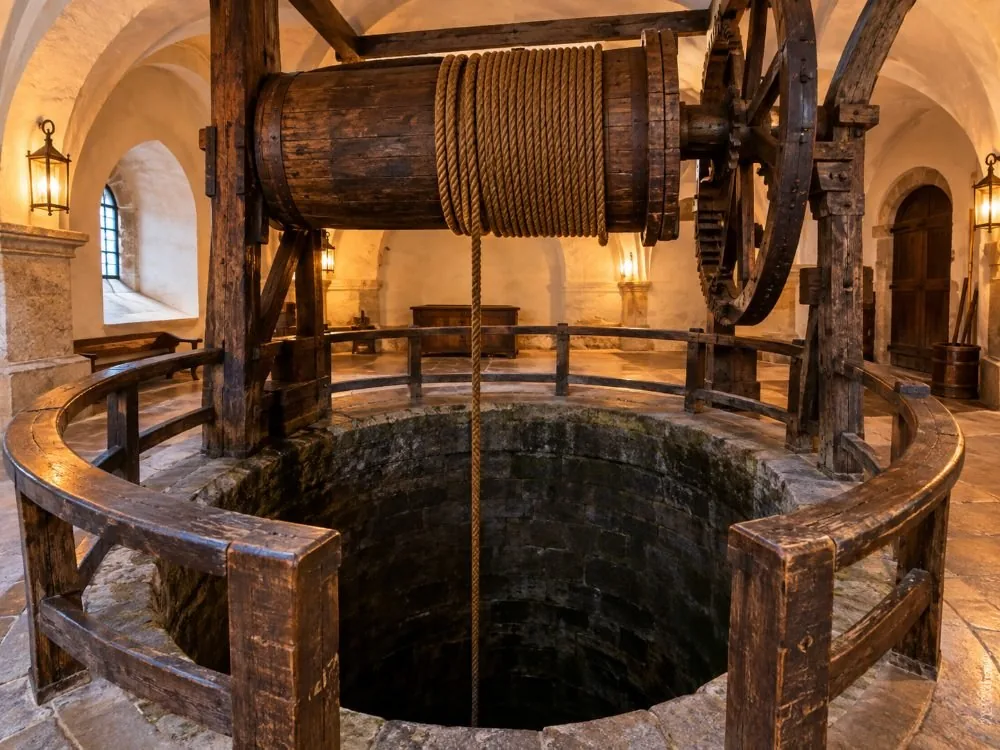
Six years through sandstone
The arithmetic is the interesting part. A garrison on a table mountain 240 metres above the river has no water unless it makes some, so the Elector imported the only people in Saxony who knew how to sink a deep shaft: silver miners from the Erzgebirge. They took six years, and during the work roughly 8 cubic metres of water a day had to be hauled out of the hole before anyone could keep digging. The shaft they left is the single piece of engineering on this rock that still stops people mid-sentence, and it is the one stop I would not skip on a short visit.
The house over the top of it
The Brunnenhaus was built by the fortress master-builder Jean de Bodt between 1735 and 1737, with a bombproof sandstone vault, and reinforced again in 1881. A hole is a hole; what you actually walk into is de Bodt’s building. The former guard wing of the same structure now holds the two holiday apartments, which are the only beds on the rock — that oddity is on staying overnight.
Stand at the rail and wait rather than looking. The depth registers through your ears, not your eyes, and the demonstration is worth queueing thirty seconds for.
Deepest in Germany, and other things it is not
Secondary sources upgrade this well constantly, usually to a German or a continental record. The fortress makes no such claim on its own pages, which ought to settle it. Burg Kyffhausen in Thuringia has the deeper shaft. Lead with 152.5 metres and 1569 and you have said something true and specific, which is better than a superlative somebody will correct. Where the well sits in a sensible walking order is on what to see on the fortress.
Seeing the well with someone talking
The fortress-focused day out of Dresden and Pirna runs nine to twelve hours with groups limited to seven or eight, in English, Spanish, Czech or German. Hotel pickup, a guide, lunch at the castle and the fortress visit are all listed as line items, though the page never uses the word admission, so read that line as listed rather than settled. No rating and no reviews yet — it is a new listing, and I am not going to dress that up.
Frequently asked questions
How deep is the well at Königstein Fortress?
152.5 metres, sunk between 1563 and 1569 under the direction of Martin Planer, a mine surveyor from Freiberg, and dug by miners from the Ore Mountains. Around 8 cubic metres of water a day had to be removed during construction.
Is it the deepest well in Germany?
No, and the fortress does not say it is. It is the deepest well in Saxony; the shaft at Burg Kyffhausen in Thuringia is deeper. The number that matters is 152.5 metres, not the ranking.
Who built the well house?
Jean de Bodt, the fortress master-builder, between 1735 and 1737, with a bombproof sandstone vault that was reinforced in 1881. Its former guard wing now holds the fortress’s two holiday apartments — see staying overnight.