Who Climbed Into Königstein Fortress?
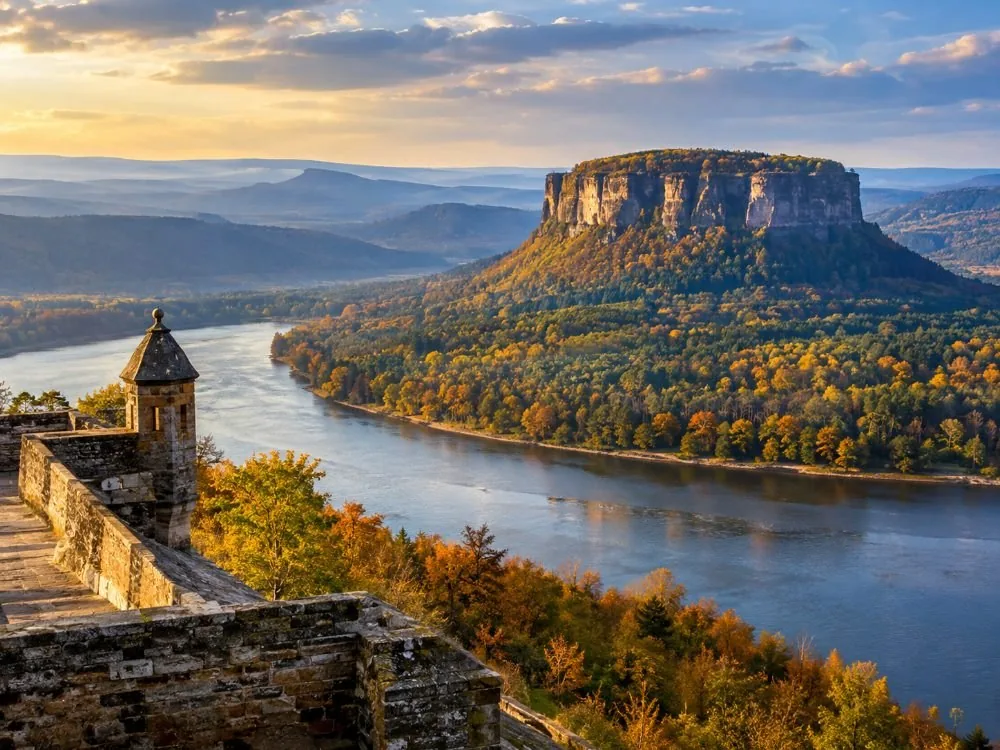
The climb
He was born on 22 August 1829 at Mahlis and he was eighteen when he did it. The wall and the cliff face below it reach 42 metres, and he went up a crevice in the sandstone with nothing but his hands and the technique of a trade that spent its days inside chimneys. Ninety minutes later he was standing on the rampart of a fortress no army had ever entered, listening to the noon bells, entirely alone and entirely visible. The guard took him within minutes.
How long he was held afterwards I cannot tell you, and neither can anyone else honestly. The accounts range from half a day to twelve days, which is a wide enough gap that picking one and stating it would be inventing history. So: somewhere between half a day and twelve days.
What became of him
Not much that was good. He published a booklet about the climb and tried to live off it. He was in the workhouse from 1860, in prison from 1865 to 1870, and died in police detention in Dresden on 26 January 1897. The fortress that arrested him now calls his climb the Ersteroberung, the first conquest, which is a description I find hard to argue with given how the rest of the military record reads — see was it ever conquered.
The Abratzky-Kamin today
His crevice is a climbing route. It runs roughly 34 metres, was first re-climbed in 1923, has been in the guidebooks since 1991 and is graded IV on the Saxon scale. A modern ascent takes fifteen to twenty minutes, and climbers must abseil back down afterwards, because going over the fortress wall at the top is forbidden — which means that in one respect nobody has repeated what he did. The fortress runs a guided climb in his footsteps; what is guided up here and what is not is set out on guided tours.
Everyone else goes through the Torhaus. If you want to understand the scale of what he did, walk the outer circuit and look over the parapet on the town side, then remember he was eighteen and had no rope.
Going up the ordinary way
Of everything sold online under this fortress’s name, one product is actually built around it rather than around a photograph of it: nine to twelve hours from Dresden or Pirna, small groups capped at seven or eight, with hotel pickup, a guide, lunch at the castle, the Lilienstein climb and the fortress all listed as line items. It is flagged as a new activity and carries no rating and no reviews at all, which I would rather tell you now than let you discover at the checkout.
Frequently asked questions
Who was Sebastian Abratzky?
A chimney sweep from Mahlis, born 22 August 1829, who on 19 March 1848 free-climbed the outer sandstone wall of Königstein Fortress at the age of 18 to get in without going through the gate. He took about 90 minutes and reached the rampart at noon, where he was arrested. He died in Dresden on 26 January 1897.
What punishment did Abratzky get?
Nobody can say precisely. The surviving accounts put his detention anywhere between half a day and twelve days, and I would rather give you the range than pick a figure. His later life went badly: the workhouse from 1860, prison from 1865 to 1870, and death in police detention.
Can you climb the Abratzky-Kamin today?
Yes, as a graded climb — roughly 34 metres, IV on the Saxon scale, first re-climbed in 1923 and in guidebooks since 1991. Ascents take fifteen to twenty minutes and climbers must abseil back down, because crossing the fortress wall at the top is not allowed. Everyone else arrives by lift, road-train or footpath.