What to See at Festung Königstein
A walking order that works
The fortress does not impose a route and the signage lets you wander. This is the order I used when I guided in the casemates, and it has one virtue: it saves the wall circuit and the long view for the end, when your legs have stopped noticing the climb.
1. The Torhaus and the ramp
Built between 1589 and 1591 when Elector Christian I turned a hilltop castle into a state fortress, with a three-wing façade and the ticket windows underneath it. Everyone walks through it and almost nobody looks up at it.
2. The Streichwehr
The flanking battery of 1591, with five casemates. This is the cool, damp, echoing part of the site, and the part I would take a child to first — see visiting with children for the rest of that argument.
3. The Georgenburg
Properly the Johann-Georgenburg. The medieval nucleus of the whole place, rebuilt from 1605, given its arcades then, and renamed in 1619. If you want to know where the fortress starts, it starts here.
4. The garrison church of St George
The oldest structure on the rock: late Romanesque, from the early thirteenth century, rebuilt in late Gothic by Duke George the Bearded in 1516, consecrated as the Georgenkapelle in 1676 and re-consecrated in 2000. Galleries, a Jehmlich organ, restored ceiling paintings. It is described as the first Saxon garrison church, and it is still in use — services, weddings, baptisms, and the Sonntagsmusiken concerts. The exhibition inside runs April to October.
5. The Brunnenhaus and the well
152.5 metres deep, sunk between 1563 and 1569 for Elector August, surveyed by Martin Planer from Freiberg and dug by miners out of the Ore Mountains, who had to lift about 8 cubic metres of water a day while they worked. The bombproof sandstone well house over it is Jean de Bodt’s, built 1735–1737 and reinforced in 1881. It is the deepest well in Saxony. It is not the deepest in Germany, whatever the coach guide said — Burg Kyffhausen is deeper, and the fortress itself makes no record claim at all. The well has its own page.
6. The Magdalenenburg and the Riesenfass
The Magdalenenburg was a pleasure palace of 1622–1632, turned into a provisions magazine in 1819. The giant barrel beside it is a replica, and I would rather you heard that from me. The Königsteiner Riesenfass was built between 1722 and 1725 for Augustus the Strong, held 249,838 litres, decayed, and was dismantled in 1818. The original is gone.
7. The two Zeughäuser
The old arsenal of 1594 and the new one of 1598, now holding the military-history collections. This is where you find out that a fortress is mostly a logistics problem with cannons on top.
8. The Friedrichsburg
Put up in 1589–1591 as an observation tower called the Christiansburg, then redesigned in 1731 into the baroque pleasure pavilion standing there now. A watchtower that became a party room is a fair summary of what happened to this fortress after artillery outgrew it.
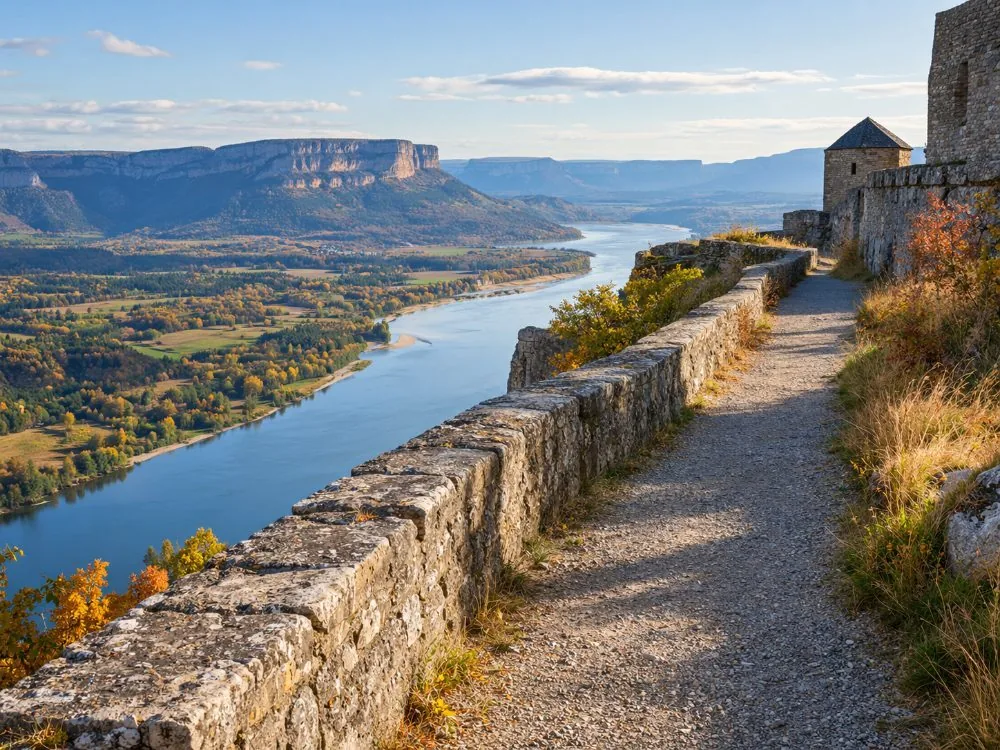
9. The wall circuit
About 1.8 kilometres round the top of the cliff — the fortress says roughly 1.7, Saxon Switzerland tourism says about 1.8, and the difference is where you start counting. On the way you pass the ground between the Königsnase and the Blitzeichenplateau where General Giraud went down a rope in April 1942, and the top of the Abratzky-Kamin, the crevice a chimney sweep free-climbed in 1848. Finish at the Blitzeichenplateau, which is also where the beer garden is.
The exhibitions
In lapide regis — “on the stone of the king”, the phrase used of this rock in a boundary document of 1241 — opened on 1 May 2015 across 33 rooms, many of them public for the first time. It is subtitled 800 years of life on the Königstein and it is the reason a thorough visit turns into half a day. Alongside it there is Sturm auf den Königstein, an immersive piece about defending the place, the underground passages and casemates, and a Cold War bunker tour.
If you do one thing indoors, do the 33 rooms. If you do one thing outdoors, do the circuit. Fitting both plus a guided tour into a single visit is covered on how long you need.
The church exhibition, the beer garden and most of the catering run April to October. A February visit is the walls, the well house, the arsenals and the permanent exhibition, which is still a good day, but it is a different one.
What is not up there
No hotel, no permanent residents, and no original wine barrel. Napoleon was never imprisoned here either — he came for about an hour in 1813, approved of the works and walked back down. The prisoners were other people, and there is a list of them.
Seeing it with someone who knows it
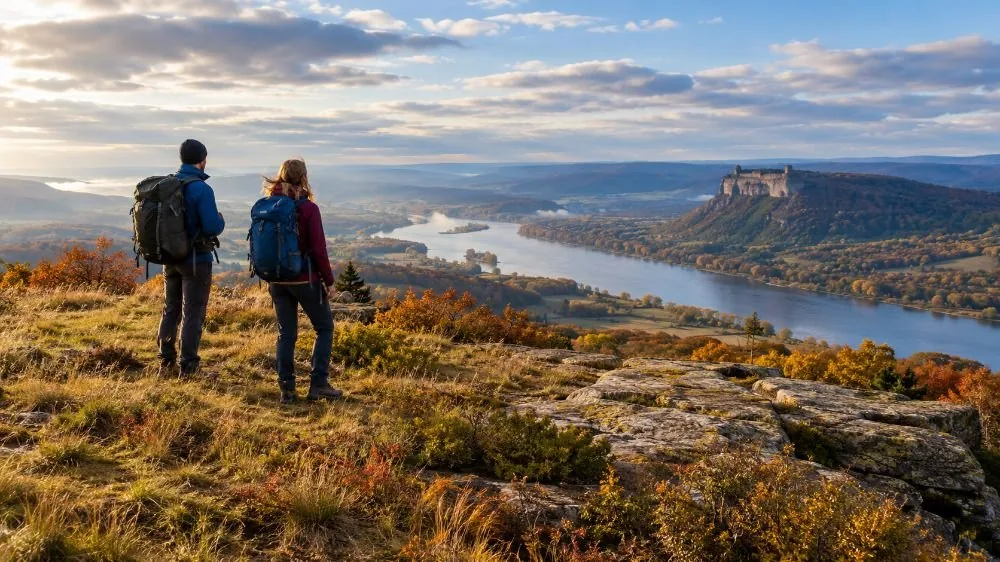
The one tour on the platform built around the fortress rather than around the national park, limited to seven or eight people, running in English, Spanish, Czech and German. It is new, with no rating and no reviews yet. The alternative is the fortress’s own audio guide in ten languages, argued out on guided tours.
Other ways to reach it
 Built around the fortress
From Dresden: Lilienstein & Königstein Tour
 Most booked
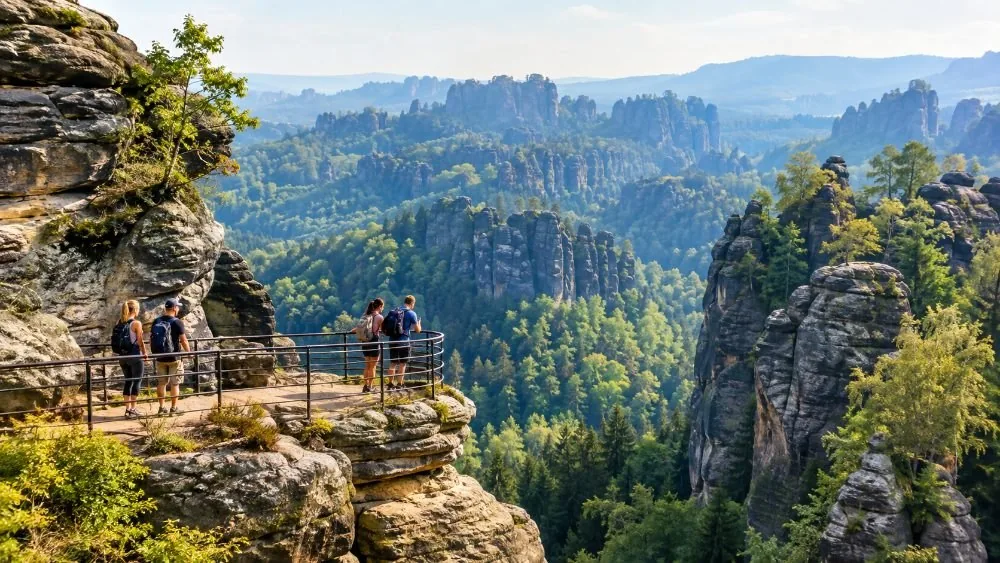
From Dresden: Saxon Switzerland National Park Full-Day Trip
 Arrive by river
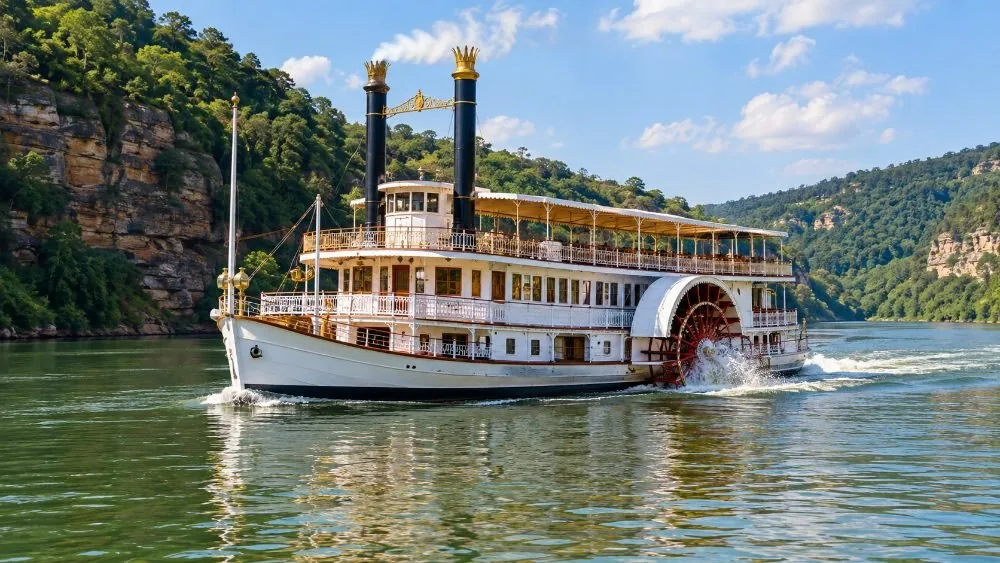
Dresden: Königstein Fortress Paddle Steamer Cruise
Whichever you pick, you still have to get from the car park or the landing stage to the gate, and that is its own small problem — see getting up the rock.
Frequently asked questions
How long does it take to see everything at Königstein?
Two to three hours covers the wall circuit and the headline exhibitions, which is what the fortress itself recommends. All 33 rooms of the permanent exhibition plus a guided tour realistically makes it half a day. How long to visit breaks it down by the time you actually have.
What is the oldest building on the fortress?
The garrison church of St George. It began as a late Romanesque chapel in the early thirteenth century, was rebuilt in late Gothic in 1516, consecrated as the Georgenkapelle in 1676 and re-consecrated in 2000. Its exhibition is open April to October and it still holds services. More of the sequence is on the history page.
Is the giant wine barrel real?
The one you see is a replica. The Königsteiner Riesenfass was built between 1722 and 1725 for Augustus the Strong and held 249,838 litres, but it decayed and was dismantled in 1818. Nothing of the original survives. Several other things visitors repeat about this place are wrong too — start with never conquered.
Can you go underground at the fortress?
Yes. The Streichwehr of 1591 has five casemates, and there are underground passages and a Cold War bunker tour on top of the above-ground buildings. I guided in the casemates for three seasons and they are the coolest place on the rock in August, in both senses. Bring a layer — see what to wear.